|
|
|
|
|
|
|
|
    
|
|
|
|

|
Ver la página
en Español
Did you know having conversations with
children on a regular basis and using rich vocabulary
predicts the oral skills they’ll have by 1st and 2nd grade? A
child’s level of literacy in 1st grade is a very strong
indicator of what their level will be in 4th grade -----and
beyond.
What does this mean?
It
means that you have simple tools at your fingertips to
increase your child’s language skills, which directly
influences their literacy.
And it’s
fun!
_______________________
|

|
|

|
See
below for fun ways to increase a child's literacy!
Conversations
at Mealtimes
Songs
Reading or Storytelling
Visit Your Local Library
|

|
|
|
Conversation
at Mealtimes:
“Mealtime
is often a young child's best opportunity to engage in
interesting conversations with adults.”
Catherine Snow,
professor at Harvard's Graduate School of Education.
During breakfast, lunch or dinner encourage your
child to talk about their day.
You
can start by sharing first. If you talk about your work day, they’ll
learn the unique vocabulary words associated with your
job. If you are preparing dinner, talk about the process
of cooking while you are preparing. They’ll learn new
words like grater or sifter!
Children who talk about their day also get a
chance to ‘narrate’ their adventures in interesting ways. Not
only is this entertaining, but research shows a strong
connection between early reading success and children who are
able to have conversations beyond the ‘here and now.’ That
is, they talk vividly about other times and places, such as
talking about their trip to the zoo. (Snow, Dickinson 1987).
Mealtime conversations are special because they
are with family or friends,
thus
more meaningful and personal. Children share and absorb much
more
during
these moments.
_______________________
|
|
|
|
Songs
Songs are a fun way for young children to learn
new words and language skills…
the
rhythm and music will hone these skills with a tune!
Try making up a song about something you see
while you are driving or doing an everyday activity. Ask your
child to make one up too! Put in funny sounds that make
it
silly and keep their attention. You can use a familiar tune
and just change the words:
|
|
|
|
“Twinkle, twinkle little star,
It’s so much fun to drive our
car (honk honk!).
Up above I see a light, it is
red and what a sight!”
You can also play a CD or podcast of favorite
children’s songs (with words) and encourage your child to
sing along. Or, a grandparent can teach them a special song.
|
|
|

|
_______________________
Reading or Storytelling
“It’s not just reading the
words, but having interesting conversations about the book
that helps children build stronger oral-language
skills."
Patton Tabors, research
coordinator. Language-Rich Home and School Environments Are
Key to Reading Success
We all know reading to children increases
their reading skills. But did you know that it is just as important to talk about the
book or story afterwards?
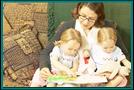
If you are reading to a child, create a
warm, personal experience by having them sit on your lap or
sit next to them in a comfy chair. Perhaps have a ritual item
they wear when it’s story time, like their favorite fuzzy
slippers. Invite them into the world of the story by
reading with a rich tone or dramatic flair. You can use
different voices for the characters… or they can chime in and
try it!
Storytelling without a book can also be
very effective. Share a folktale or a story of one of your
parents or ancestors. Put your child in the tale! Have an
older sibling or grandparent tell them a story, passing down the history and oral
traditions of your family.
|

|
|

|
After the story spend a few minutes talking
about the story.
Ask
open ended questions that encourage thought and conversation,
such as:
"Why do you
think the unicorn wanted to be like the other animals?"
You
can create a craft or have your child draw pictures about the
story. Kids will remember and enjoy stories more if they can connect to them personally!
_______________________
|
|
|
|
Visit Your
Local Library
Besides finding wonderful children’s
books, libraries are great places
to find quality
family
programs and events for free! Many
libraries have story times or guest storytellers that can
peak your child’s interest in stories and books. After
attending a program, ask your child how they enjoyed the
experience or to tell the story they heard.
This
increases their speaking skills, imagination and social
confidence.
And of
course the enjoyment of re-telling a tale!
Call your local library or visit their website
to find out about their special story or literacy
events. If transportation or time is a factor, try
carpooling or taking turns attending them with your friends
who also have kids.
At
the library, you just might find a book or two that you like
too!
|
|
|
|
|
Parents:
Remember… YOU are a key to your child’s literacy!
|
|
Copyright 2022
by Showstoppers. All rights reserved. No images on this page,
may be reproduced or transmitted by any means, including
photocopy, recording or any informational storage or retrieval
system, without permission in writing from the copyright owner.
###
____________________________________
|
|
|
|
|
|
|
|
|
|
|
|
|
|
|
|
|
|
|
|
|
|
|
|
|